
few days after his 57th birthday, Femi Otedola,
Nigerian multibillionaire and businessman, made
history by donating N5 billion for the care of
children facing extreme challenges as a result of
Boko Haram insurgency in the northeast.
According to Vice-President Yemi Osinbajo, this is
the largest donation to charity by a single individual
in the nation’s history.
The donation was made to Save the Children, the
100-year United Kingdom-based charity, to support
its intervention in about 16 states of the federation
where the Charity organisation operates in Nigeria,
reaching over 23 million children across the country.
Without running a foundation, Otedola is making a
strong statement as one of the country’s biggest
donors to worthy causes.
His second-biggest donation is his commitment to
building and donating a faculty of engineering
valued at N2 billion to the Augustine University in
his hometown, Epe, Lagos state.
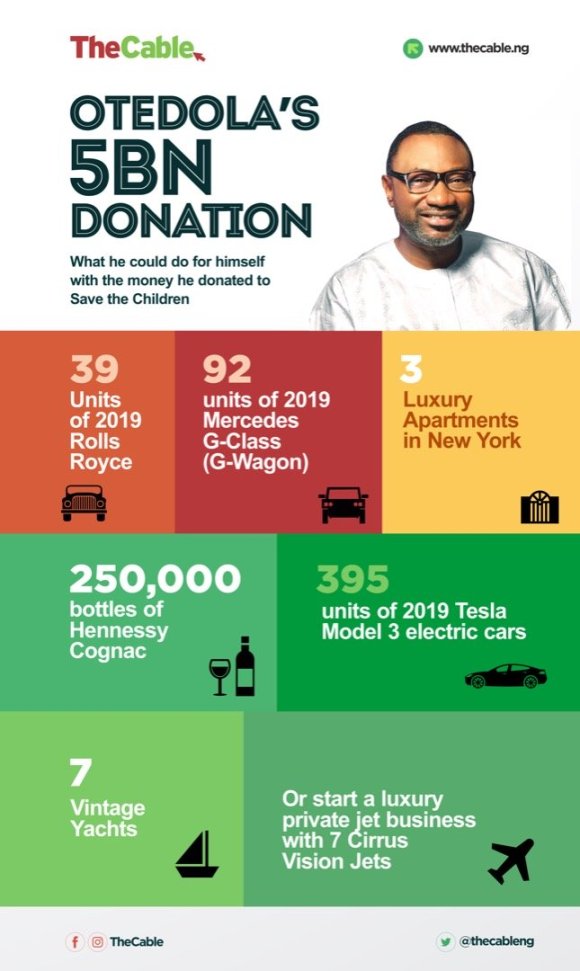
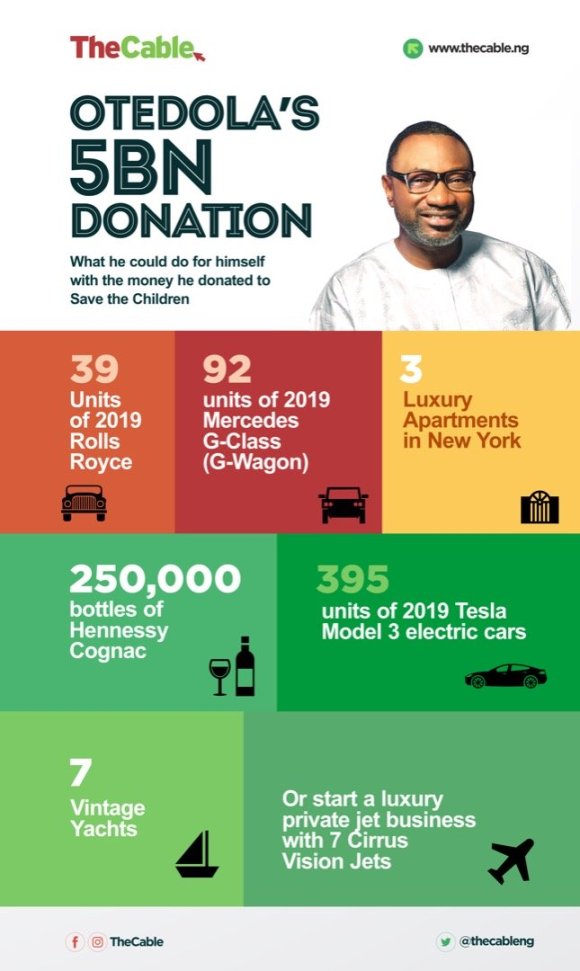
TheCable takes a look at what Otedola could have
done with his N5 billion donation — if he was
following in the footsteps of an average billionaire.
A LIFETIME OF CHAMPAGNE
How many bottles of Hennessy do you need to buy
in a lifetime? 250,000? At one Hennessy per day,
Otedola could have used the same money to by at
least 684 years of champagne. 684 years is how
many lifetimes?
While donating $50,000 to former Super Eagles
Coach, Christian Chukwu, Otedola said: “In my
circle of friends, many people spend up to N50
million to drink champagne and generally ‘enjoy’
life, but at the end of it all what happens? It passes
out of their body as waste. For me therefore (and I
also tell my friends) it is important to use such
money to benefit others and put a smile on the
faces of as many people as we can.”
If Otedola was to follow his friends, he would still
need to host at least 100 lavish parties to spend
N5billion on champagne.
Therefore, this donation
can also be seen as forfeiting 100 lavish parties.
7 VINTAGE YACHTS
According to Boat Internationational, it cost about
N255,000,000 to buy a 1976 Ocean Romance Yacht
off its vintage collection. With N5 billion, Otedola
could have easily bought about 19 of these yachts.
But most vintage yachts do not come in as many
pairs. So most billionaires have to diversify their
collections by buying different brands.
With N5 billion, the Nigerian businessman can buy
at least seven of some of the finest yachts in the
collection.
92 MERCEDES G-WAGON (2019 EDITION)
The 2019 Mercedes G-Class is the rave in town by
some of the richest in Nigeria. It cost between
$125,000 to $150,000. With N5 billion at your
disposal, you can buy 92 units of this luxury vehicle,
and perhaps have some change — depending on
the model you settle for.
Think of this as a luxurious car business in a Benz-
crazed Nigeria, but Otedola will decide that it was
better to use these billions for the struggling in
society, than serve to the orders of his class of rich
businessmen in Nigeria.
7 PRIVATE JETS AND OTHER LUXURIES
In 2017, a famous bank chairman in Nigeria quit his
active role in the bank to start a private jet
business, which he considered his next challenge.
Despite the initial clampdown under President
Muhammadu Buhari on some of these luxury items,
the business is expected to boast of a good
number of jets and so heavy cash flow.
To attempt this business with N5 billion is also a
possible way for Otedola to spend his money.
Brand new Cirrus Vision Jet costs about N723
million. With N5 billion, Otedola could easily buy
seven of these jets.
As a businessman in real estate, the former Forte
Oil chairman could easily buy luxury apartments in
any part of world, including one of the world’s most
expensive cities, New York.
The same money could also buy 39 units of 2019
Rolls Royce, regarded as some of the most
expensive luxury cars in the world today. It would
be easy to become friends with Elon Musk, the
billionaire Tesla CEO, by simply buying 395 units of
fully electric 2019 Tesla Model 3, which costs a
little over N12 million per unit.
Philanthropy makes up two percent of the United
States gross democratic product (GDP). According
to Bill Gates, this covers for what the governments
cannot do, and what the private sector is also not
doing. He says philanthropy is important to the US
economy.
For Nigeria, it remains unknown, how much of the
GDP is made up of charitable donations, but with
the likes of Otedola in the space, the numbers are
definitely growing, and may soon be well-studied
and measured in GDP reports.

 Young-po Reporters