
Editor’s note: Lagos-based public affairs analyst,
Victor Aluede, reviews the controversial trending
issue of the Nigeria Presidential Electoral Tribunal (Npel) which is the
one of the major cases in the Nigeria political polity
with emphasis on the recent court proceedings
involving the case. Therefore I victor approve this opinion on this media concept
Ugochimereze Chinedu Asuzu speech
Distinguished Readers;
In this edition of my weekly political analysis, i
just could not but delve into the nitty gritty of the
judgement of the PEPT, in respect to the case
involving the candidate and party of the PDP versus
the candidate and party of the APC. This judgement
has since painted a gloomy picture and almost
making nonsense of the age long saying that the
judiciary is the hope of the common man. In this
discourse, we shall attempt at adding our voice to
the avalanche of others who since the judgement
was handed down have spoken their minds; mine took a little time coming, Though those following me on
social media, especially via my Facebook handle
are already aware of my partial take on the
judgement, as I am aware I have penned down
some thoughts concerning the judgement. Now let
us really speak our mind in this piece and lay same
bare for posterity sake.
Read below:
Plato, the Greek sage, once proclaimed that:
“We can forgive a child who is afraid of the dark;
the real tragedy of life is when men are afraid of
the light.
This saying is both prophetic and instructive, when
interpreted in the light of our present situation as a
country, especially as it concerns the judgement of
the Presidential Election Petition Tribunal. A
plethora of articles, comments and views have been
held by Nigerians as concerns the judgement of the
court and it’s future implications for the country.
Some of these comments are illustrative of a child
in the dark, lacking both facts and coherent
reasoning while some others are like a matured
man who pretends not to know that there is light
just because he is afraid of it. While we may easily
forgive the child, it is understandable if the adult is
despised and never forgiven. As is with every
human activity, the law as the bedrock of society,
regulates elections, evidence and election petitions.
The whole essence of the judiciary is to serve the
cause of justice by the proper application of the law
in line with facts and evidence before it. To achieve
this aim, the court must shift the chaff from the
grain and render justice to every man in the same
measure. Little wonder, Lady Justicia, the symbol of
justice is blind to status, creed, affiliations and the
like. And what is law, if the aspirations of the
people are circumvented? Even amongst the learned
fellows it is a well known truism that justice must
not only be done, but must be expressly and
undoubtedly be seen to be done. This suggest that
the decisions of the courts must be rationale and in
line with the law, and not merely for political
correctness, cos it is only then that justice will be
said to be done.
Following the declaration by the Independent
National Electoral Commission (INEC) that Mr.
Muhammadu Buhari, the candidate of the All
Progressives Congress (APC) was returned as duly
elected as the President of the Federal Republic of
Nigeria in the duly contested elections, the People’s
Democratic Party (PDP) and its candidate, Alhaji
Atiku Abubakar, petitioned the Tribunal within the 21
days period as stipulated by the Electoral Act and
of which judgement was given within the mandatory
period of 180 days. The judgement of the tribunal
and the implications of such judgement has been
the subject of much debate. While one may not
write as an authority in law and jurisprudence, it is
still a sacred duty owed the society and the cause
of justice, especially as enlightened and positively
exposed individual, who have by acquaintance and
experience come to understand howbeit basic, the
proper interpretation or interpolation of the law, and
the basic ingredients of a sound, reasonable
judgement, to write and rationalise judgements
especially those that can have effect on the nation
and its future could be counterproductive. It is
necessary to state that when judgement is unfairly
given, more so in a matter for which proper judicial
precedents was anticipated, and the very hopes of
those positively looking up to proper interpretation
and clarifications to be made are quashed, it
behooves the enlightened public to ask questions
and understand the rationale behind such
judgements.
Since the hearing of the petition, Nigerians followed
with keen interest through the proceedings until
judgement was delivered unanimously by the full
court without any of the Honourable Justices
dissenting. The Court of Appeal, sitting as the
Tribunal is vested with jurisdiction to entertain
election petitions in presidential elections. The
judgement of the tribunal is as regards the petition
against the All Progressive Congress (APC), and its
candidate General Muhammadu Buhari and the
Independent National Electoral Commission, by the
People’s Democratic Party (PDP), its candidate,
Alhaji Atiku Abubakar, following the declaration of
the candidate of the All Progressives Congress,
President Muhammadu Buhari as duly elected and
returned as winner by the INEC, a declaration which
some others that participated in the said election
refused to accept as the true position, thereby
rejecting same as incorrect interpretation of the real
position of things.
This decision of the tribunal has not gone down so
well with a large percentage of Nigerians, as
majority viewed the judgement as travesty of
justice, while a lot more believe that the judgement
is an error in law. As is always with democracies,
where elections are won and lost, some supporters
of the present government praised the decision of
the learned jurists, as proper. Since the dossier is
not tailored towards making legal arguments for or
against the judgement, and for want of space, we
would not dive into the deep ocean of the legal
aspects of the judgement, however a word or two
which has legal colourations may present itself
handy in the course of this discourse. Essentially of
much importance to the writer, is the futuristic
implications the ruling holds on Nigeria as a
country, and the fact that a gloomy picture of
hopelessness and despondency is daily being
painted, more so by those Nigerians looks forward
to to salvage their debilitating situation.
Recall, that the focal points of argument in the said
petition of the PDP and her candidate centred more
on the pre-qualifications of Mr. Buhari and the
controversies that followed it.
A candidate in an election is to state his
qualifications before, and not after the elections by
filling CF001 which is the form which evidences his
educational qualifications. As such, any line of
qualifications chosen by such person may make or
mar him, as he is deemed to float or sink with it.
The President, Mr Buhari, stated that he has the
Secondary School Certificate and not its equivalent,
and as such the burden is on him to prove the
existence of the result. The court lacked the vires
and erred in law by enlarging the educational
qualifications of Mr Buhari to include other
certificates which he did not rely on in his CF001.
As such, affidavit which was sworn by Mr Buhari
showing that he obtained the Secondary School
Certificate and that they are in possession of the
Army even when denied by the Army was held by
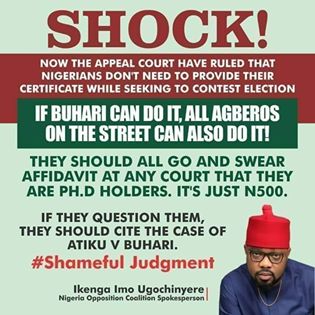
the court to be supreme. If this decision is allowed
to stand, an evil precedent would be set, as is
demonstrated by many of our youthful population
who now ascribe to themselves fictitious certificates
following the footsteps of their President after
swearing to an affidavit. In a more serious note, the
judgement made mockery of the relevant provisions
of the Constitution as regards educational
qualifications.
More disheartening was the overt act of the tribunal
who went into the arena of litigation and severally
attempted to defend the President in the face of the
heavy evidence before them. They threw up
assumptions and imagined even when there are
superior evidence against such assumptions that the
President was eminently qualified. The question one
will be quick to ask is, following the judgement of
the tribunal, what is the educational qualification for
a person aspiring to be the President? The simple
answer as stipulated by the tribunal is: Ability to
read and write and an affidavit that swear on oath
that you obtained a certificate.
Is this not a mockery of education and an invitation
to mediocrity in our national life?
It is the words of the wise to say that a man can
not say yes and no at the same time; this is no
longer the case following the judgement of the
court when it stated that an old witness cannot lie
even when the witness lied on oath. The President
who is unable to prove his certificate was held
eminently qualified whereas a person who argues
that the President lied on oath by making a false
declaration knowing fully well that there is no
certificate anywhere was held out by one of the
Justices to have made an allegation of perjury and
continued to make excuses and find grounds to
defend the President.
Though some schools of thoughts are of the
opinion that Atiku Abubakar and his party PDP
should jettison the idea of approaching the Supreme
Court, they say so because they reason or are
already disenchanted with the conducts of the
Nigerian judicial system, however this writer is of
the opinion that Atiku Abubakar and his party PDP
should go the whole hug in the pursuit of justice,
which even as a layman is obvious to us that it was
roundly denied them at the appeal court; not
unmindful of the fact that it is being muted in some
quarters that the judiciary is been conquered already
and badly compromised, nevertheless, the writer is
still with some measured expectations that the court
might yet redeem itself from at that level, reason
being that it ought to understand and see through
the mood of the country concerning the judgement
of the learned jurists of the appeal court and its
attendant unhealthy disaffection from the people.
Unless the Supreme Court corrects this evil, the
precedent seems to have been set that a man do
not need to show prove of his qualifications, an
affidavit stating that such qualifications were
obtained will suffice, that for me is the
interpretation of the judgement as handed down by
the court, and its patently dangerous a precedent to
be laid.
Shalom+

 Young-po Reporters