
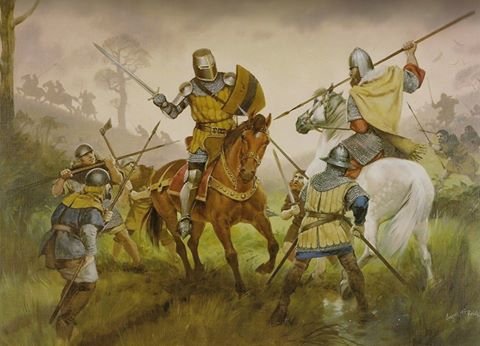
700 years ago today in 1318 A.D., in an age of
great famine and pestilence, on the edge of the
known world in Ireland, Edward Bruce, claimant to
the throne of Ireland and brother of the better
remembered King Robert the Bruce of Scotland, met
his doom at the Battle of Faughart in county Louth,
outside Dundalk, by Hiberno-Norman forces led by
John de Bermingham, thereby ending Edward’s
invasion of Ireland and bringing a definitive end to
any further attempt to create a grand Gaelic alliance
between Scotland and Ireland against England (the
Bruce pictured in battle).
Edward had originally crossed the northern straits
from Scotland into northern Ulster in 1315 A.D with
an army of some 6,000 men. At this time King
Robert was still at war with King Edward II of
England, son of the mighty Edward Longshanks.
With the loss of the Isle of Man to the English, the
victor of Bannockburn sought to recreate a second
front with which to harass the English and
earmarked Ireland as the ideal place to do so after
Domhnaill mac Briain Ó Néill of Ulster called for
Scottish aid against further Anglo-Norman
incursions into his kingdom. The Bruce brothers
planned for Edward to take the country and make
himself King before invading Wales with the hope of
harnessing yet more anti-English sentiment there
while Robert reconquered the Isle of Man and
thereby create a grand alliance of Gaels and Britons
against the Plantagenets. What they envisioned was
nothing less than a grand reshaping of the Western
Isles that would see English Plantagenet hegemony
replaced by the Bruces of Scotland.
Edward’s invasion at first was a tremendous
success. The Hiberno-Scottish army which he
commanded seemed near on unstoppable as they
won battle after battle. He failed however to seize
Dublin, the seat of English power in Ireland. This
combined with the fact that he had little support
from the Gaelic chieftains outside of Ó Néill’s
territories in Ulster meant that he was never able to
consolidate his control either by might or by right.
When famine swept the country with fingertips of
hunger, he proved unable to feed his men and was
forced to acquire supplies by beating it out of the
local populace. His campaign of ‘liberation’ from
English rule turned into a barbaric plundering raid.
The Scots seemed little better to the Irish Gaels
than their English predecessors. All of this served to
stifle any further aspirations. Only with the slight
improvement of conditions in 1318 A.D did the
opportunity arise to finish the business at hand and
save his enterprise.
Commanding only a few thousand men he made a
desperate gamble and took on an enemy force said
to have been some 20,000 strong. Whether such
numbers were exaggeration or not the fact stands
that Edward faced far superior numbers and though
he was no doubt an experienced commander, he
faced near certain defeat. As his Gaelic Irish allies
were opposed to taking on such a foe – it being
considered unwise in Gaelic warfare to engage in
battle unless absolutely certain of victory – Edward
placed them at the rear while he and his 2,000
Scotsmen took the vanguard and resolved
themselves to die by the sword. The Bruce
deployed his troops in three columns upon the hill
of Faughart.
This division of his army proved fatal as John de
Bermingham simply steamrolled forward and
annihilated the isolated Scottish columns one after
another, none of them being able to support one
another. Bruce’s army swiftly disintegrated, leaving
only Bruce’s own column left which according to the
chroniclers “was routed just as the two preceding
ones had been. Edward fell at the same time and
was beheaded after death; his body being divided
into four quarters, which were sent to the four chief
quarters of Ireland,” and his head being sent to King
Edward II. Amongst the dead were also the Mac
Ruaidrí of the Hebrides and the Mac Domhnaill of
Argyll.
The Scottish position in Ireland thereafter melted
away, the termination of the war being greeted with
alacrity as is evident in the Annals of Ulster which
recorded Edward as “the destroyer of Ireland” and
as a scourge to “both foreigners and Gaels” and
that “there was not done from the beginning of the
world, since the Fomorian race was expelled, a
deed that was better for the Men of Ireland than
that deed” of his defeat and death. That said
however Bruce’s invasion ultimately brought an end
to English raids being launched from Ireland against
Western Scotland and also very nearly brought the
Norman settlement of Ireland to complete and utter
ruin, leaving it weak and enfeebled when the Black
Death struck a few decades later.

 Young-po Reporters