
689 years ago today in 1330 A.D., sixteen years
after glory was won on the field of Bannockburn, on
the distant field of Teba in Spain, Sir James ‘The
Good’ Douglas, also known as ‘The Black Douglas’,
was slain with a sword in his hand as he took on
manifold Granadan adversaries. A firm friend and
comrade of Robert the Bruce, the Black Douglas
played a pivotal role in the War of Independence
and died a hero of Scotland
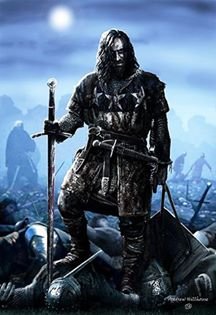
Douglas by artist Andrew Hillhouse pictured).
Born at some point in the late 1280s, Douglas was
the son of William Douglas the Bold whom had
pledged his allegiance to William Wallace during
the wars with Longshanks. The elder Douglas was
captured shortly before the Battle of Stirling Bridge
and died in the Tower of London in 1298 A.D.
During this time the young Douglas was sent away
to be educated in France where he became the
squire of Bishop William Lamberton of St. Andrews.
By the time he returned to Scotland in 1304 A.D his
family’s ancestral lands had been confiscated by
the English and though he appeared before
Longshanks himself requesting that they returned,
the ‘Hammer of the Scots’ did not so lightly forget
the deeds of his father and promptly dismissed
him. This effectively left Douglas as a landless
exile, longing and patiently waiting for an
opportunity to reclaim his ancestral home. Under
the current status quo that proved to be impossible
yet in the aftermath of Robert the Bruce suddenly
killing his rival John Comyn at Greyfriars Kirk, the
space was opened up for a new order in which the
Douglas could make his move. As the Bruce rode
for Glasgow and then Scone to be crowned King, he
met the outcast Douglas on the peak of a hill now
known as the Crown of Scotland. There the two
men met and Douglas pledged his allegiance to the
Bruce, the two of them becoming fast friends as
they set out to defy the English.
Noble as their hopes were however, the odds were
not in their favour.
The Scottish army has being
hammered to a pulp at the Battle of Methven in
1306 A.D at the hands of Aymer de Valence and
then was thrashed at the Battle of Dail Righ by the
Mac Dougalls of Argyll, thereby relegating the
Bruce’s forces to mere fugitives. Having been so
thoroughly pulverised in open battle,
the Bruce and
Douglas together chose to pursue an alternative
means of warfare in which their inferior numbers
would be to their advantage. They launched a
guerrilla war of hit-and-run tactics to agitate and
frustrate the enemy and Douglas led his own
campaign in the south of the country whilst the
Bruce was trying to put his house in order in the
north. Fighting around his own ancestral lands, he
proved himself to be an able commander and a
relentlessly ruthless tactician, repeatedly catching
the English off guard in ambushes. Though the date
is disputed, at some point he and his men
managed to infiltrate his family home of Douglas
Castle whilst the occupying garrison was attending
church.
Thereupon then the battle cry of “Douglas!
Douglas!” went up, swords were unsheathed and the
English soldiers were butchered to a man, those not
slain in action being beheaded later, the severed
heads set afire atop a pile of wood and wine. This
episode earned him the reputation thereafter
amongst the English as the “Black Douglas.” Not
long afterwards the great Douglas was summoned
northwards to aid the Bruce in crushing the Mac
Dougalls. At the Battle of the Pass of Brander,
Douglas outflanked the enemy with a squad of
Highlanders and tore into the rear of the Mac
Dougall army, cutting them down like chaff before
forcing them into a rout.
The Pass of Brander proved to be one of the few
pitched battle in which Douglas and the Bruce
fought at this time as they built up their strength.
For the most part Douglas continued to drive the
English mad by razing castles through infiltration
and deception and refusing to take to the field for a
straightforward contest of arms.
Finally however,
King Edward II, the weakling heir of the mighty
Longshanks, came north with an army and drew the
Bruce and Douglas to face him on the battlefield
just outside the besieged Stirling Castle. Greatly
outnumbered as they were the Scots made their
stand at Bannockburn with Douglas in effective
command of the left wing. With the English army
skewered and lacerated amongst the rattling pikes
of the dreaded Scottish schiltrons, they swiftly
faltered and took flight. Douglas’ appetite for the
blood of the enemy had not yet been satisfied and
he led a unit of horsemen to mercilessly run them
down as they fled the field.
With the English effectively booted out of Scotland
thereafter and the war taking to new theatres such
as in Ireland with the Bruce’s brother Edward,
Douglas took the lead in a new border war. Riding
astride small but highly mobile horses known as
hobbins, Douglas and his men would raid across
the border and strike fear into the hearts of the
people of northern England. As such the legendary
reputation of the Black Douglas continued to spread
and swell in the imaginations of both friend and foe
alike. In one raid at Skaithmuir he killed the
governor of Berwick Castle who was also a nephew
of Piers Gaveston, Edward’s II favourite. On another
occasion he killed Robert Neville, the so-called
‘Peacock of the North’ in single combat.
Such was
his fame and reputation that he was named
Lieutenant of the Realm and after the death of
Edward Bruce in 1318 A.D at the Battle of Faughart
in Ireland he was made Guardian of the Realm and
tutor to the Bruce’s son, Robert II. That same year
he launched a raid into England to divert attention
from the recently captured Berwick Castle, resulting
in the Battle of Myton wherein Douglas was faced
with a militia raised by the Archbishop of York
which consisted mostly of priests and clerics. The
Black Douglas put them all to the sword regardless,
fulfilling the strategic goal of diverting English
attention away from Berwick. In 1322 A.D Edward
made a final disastrous invasion of Scotland. Using
the same tactics used to defeat the Mac Dougalls,
at the Battle of Old Byland Douglas and his
Highlanders scaled a cliff face to outflank the
enemy before knifing through them from the rear,
sending Edward II and his army fleeing for England
again.
Following the deposal of Edward II in 1327 A.D by
his wife Queen Isabella and her lover Roger
Mortimer, Douglas pressed his advantage once
again, launching yet more devastating raids into the
north of England, once again driving the English
insane with his hit-and-run tactics.
At the Battel of
Stanhope Park, he and his men utterly humiliated
the young King Edward III by sneaking into his
camp in the dead of the night and slaughtering
scores of his men whilst they slept, only narrowly
missing the chance to capture the boy king himself.
Two years later in 1329 A.D the Bruce died. Before
he succumbed to the Kingdom of Death however he
asked his old friend to take his heart in a casket
and to embark on a crusade. The war-loving
Douglas kept his word to his friend and king and
set sail for Iberia where he offered his sword to
King Alfonso XI of Castile in his war against the
Emirate of Granada. Whilst besieging the Castle of
Teba a Granadan force under a general by the name
of Uthman tried to relieve the castle. Though their
attack faltered and they were forced to retreat,
Douglas, ready and eager as always, took chase
after them and swiftly found himself ahead of his
men and totally outnumbered. (Was captured)
According to a
legend, concocted centuries later, in his final
moments the veteran Scottish knight tore the silver
casket from his neck containing the Bruce’s heart
and said unto his enemies “Now pass thou onward
as thou wert wont, and Douglas will follow thee or
die!” Such was the fitting warrior’s death enjoyed by
the great Douglas.

 Young-po Reporters