
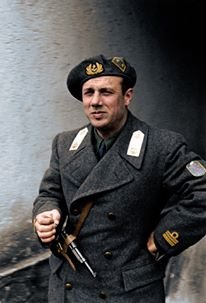
45 years ago today in 1974 A.D., the now largely
forgotten Italian aristocrat, sailor and Fascist
hardliner, Junio Valerio Borghese, also known by his
nickname as ‘The Black Prince’, died under
suspicious circumstances in Cadiz, Francoist Spain.
A brilliant naval commander during the war,
Borghese is considered one of Italy’s few war
heroes from the Second World War. His reputation
as a military man however was stained by his
extreme political beliefs and his association with
neo-fascist movements in the post-war era.
Born in 1906 with the illustriously long aristocratic
name of Junio Valerio Scipione Ghezzo Marcantonio
Maria Borghese, the Black Prince originally hailed
from Artena, Rome. Borghese belonged to a very
prominent noble family which had its roots in Siena
and whose history stretched back to the 13th
century. In the early 17th century the House of
Borghese had moved to Rome and established ties
with the Vatican with one of its members being
elected as Pope Paul V. Even in more recent times
however the family had remained prominent.
Borghese’ own father was the 11th Prince of
Sulmona and his uncle, Scipione Borghese, was
steam engine-in-trousers type of character who,
along with various other exploits and adventures,
was known for partaking in and winning the epic
1907 Peking to Paris motor race. As his father’s
second son, Borghese had the title of Patrician of
Rome, Naples and Venice and was styled as Don
Junio Valerio Borghese.
Coming from such an aristocratic background it is
hardly surprising that Borghese firstly enjoyed a very
privileged upbringing, receiving much of his
education in London before returning to Italy and
deciding to live the military life by enlisting in the
Royal Italian Naval Academy in Livorno in 1923.
Though Borghese was to do his family proud by
serving in the kingdom’s navy, he began to diverge
with them as he steadily came to identify with the
Fascist regime of Benito Mussolini that had just
come into power. Little by little he was disowned
by his family who disapproved of his political
beliefs and displayed nought but scorn for his
identification with what they would have regarded as
little better than a rabble of gangsters completely
out of bounds for a gentleman of the aristocracy.
After ten years of training and working through the
ranks however, Borghese became a submarine
commander in 1933. As a naval commander,
Borghese was to prove one of the most daring and
ground-breaking commanders in the strategic realm
of modern naval and commando warfare. Partaking
briefly in the Fascist regime’s invasion of Abyssinia
in 1935, he went on to see action during the
Spanish Civil War where he lost two men after a
British destroyer depth-charged his submarine. Only
with Italy’s entry into the Second World War in 1940
though did he truly come into his own. In August of
that year he was put in charge of a submarine by
the name of Sciré which was equipped with Italy’s
new secret weapons. Known as ‘human torpedoes’,
these weapons were small underwater assault
vehicles that could be manned by two crewmen.
Known by the Italians as ‘Pigs’ due to their poor
speed and manoeuvrability, Borghese was to use
these technological novelties to his advantage in
sabotage raids. Within a month the Black Prince
and his new ‘frogmen’ were launching raids deep
into the bay of Gibraltar. Though his missions
initially had mixed results at best, in 1941 he and
his men succeeded first in destroying a series of
merchant ships in the harbour and then a few
months later launched a daring raid on Alexandria,
Egypt, where his men severely damaged two British
battleships and two other ships. The Black Prince
and his men were all awarded medals and
promotions for their daring exploits.
In 1943 however Mussolini was overthrown and
Borghese’s unit, the Decima Flottiglia MAS was
disbanded. The Black Prince was not so eager
though to give up the fight and a few days after the
armistice with the Allies was signed he formed his
own alliance with the German Kriegsmarine to
continue the war. Fighting on behalf of the puppet
regime known as the Italian Social Republic, the
unit was reformed and before long its numbers
began to swell, having as many as 18,000 men by
the war’s ending. During this time Borghese and his
troops were known to have never deliberately fired a
shot at a fellow Italian fighting for the Allies.
At the
war’s ending in April 1945, the British gave
permission to Marshal Tito and his Communist
partisans from Yugoslavia to occupy the north-
eastern corner of Italy. When the Americans heard
of this they turned to Borghese and his men to hold
off the Communist tide until they had arrived to
push them back. The Black Prince and his men
thus marched eastward and made one final stand in
Venetia against Italian and Yugoslav partisans alike.
The fighting was so bloody that only a fifth of
Borghese’s men survived the battle.
With the final battle fought, Borghese was taken into
the hands of the Office of Strategic Services
(precursor to the CIA) who rescued him from the
partisans and had him interrogated in Rome.
Though he was tried and found guilty for
collaboration with the Nazis he only served four
years in prison out of his original twelve-year
sentence. Using his reputation as a war hero he
propelled himself into the post-war political
landscape as an ardent Fascist, becoming an
acquaintance of the radically far-right political
theorist, Julius Evola. He joined the main Neo-
Fascist party known as the Movimento Sociale
Italiano (MSI). Finding however that the MSI was
not extreme enough for his tastes however he split
ranks with them and founded his own even more
extreme party known as the Fronte Nazionale.
Following the political instability of the late 1960s
he started to plot a coup in 1970 with Stefano Delle
Chiaie’s National Vanguard. The plan involved the
kidnapping of the Italian president, the killing of the
head of police and the occupation of various key
strategic points. Thereafter he hoped to gain the
support of NATO and the US. Though there were
some within the CIA who were in favour of a
neofascist takeover there was not widespread
support for it. Borghese called off the coup at the
last moment when his conspirators were getting
into position after it was alleged that the Christian
Democratic government found out about the plans.
Finding the plan to be abandoned, the plotters left
their positions and all went for a meal of spaghetti
whilst Borghese fled the country for Spain. He lived
in exile for the last four years of his life, dying
suddenly despite being deemed healthy by a
physician just days before his death, leading many
to believe that he was assassinated with poison.

 Young-po Reporters